Right after the first frost (and again in February and March), your home may be invaded by hundreds or even thousands of Multi-Colored Asian Lady Beetles. These orange or mustard colored spotted beetles are also called the Halloween Beetle (because of their color and timing).
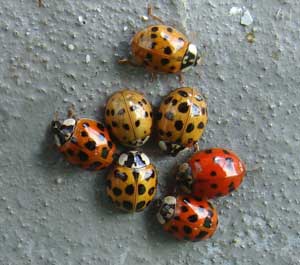 |
| Multi-colored Asian Lady Beetles are beneficial insects. They can consume 90 to 270 aphids a day. However, they can become a nuisance when they invade your house. Wikimedia commons photo. |
These beneficial insects (Harmonia axyridis (Pallas) stowed away on ships and were also introduced by the U.S. Dept. of Agriculture as a biological control. They were recorded in Connecticut in 1994. They will dine on more than 50 species of agricultural/landscape pests such as aphids and scales.
Unfortunately, because of their habit of swarming homes while looking for a place to overwinter, they can become a nuisance. They crawl inside through cracks and crevices and often cluster in corners by window or door frames.
What NOT to do:
- Don't crush or swat them--the beetles discharge a stinky yellow fluid that can stain walls, paint, and fabrics. (All lady beetles do this reflex bleeding from their leg joints when alarmed – it is a protective mechanism to keep them from getting eaten.)
- Don’t use insecticides. They are beneficial insects, and do not bite, sting, carry disease, eat your food or clothes, or reproduce inside your house. Aerosol foggers or "bug bombs" will not control lady beetles.
- Don’t suck them into the vacuum cleaner. If they die inside the vacuum they can stink. If they don’t die, they will crawl back into house.
- Buy a Biocare Alb6 Ladybug trap. It comes with a plastic jar you fill with water, a pheromone and a black light left on at night. I caught more beetles in a glass of water on my desk than I did with this trap. Commercial black light traps may be more effective.
The following methods will help control a home invasion.
DO keep them outside
- Before autumn arrives, seal cracks and openings around windows, doors, siding, and utility pipes with a quality silicone or silicone-latex caulk or weather stripping. Larger gaps can be sealed with urethane foam, glass wool or stainless steel wool, etc.
- Install tight-fitting door sweeps or thresholds at all exterior entry doors. Around garage doors, install a rubber seal rather than vinyl, which seals poorly in cold weather.
- Install insect screening (20-mesh maximum) over attic and exhaust vents. Replace and repair damaged door and window screens using regular window screening (about 18x16 mesh size.)
DO collect them indoors
- Gently collect beetles using a broom and dustpan. Or get a BugZooka which works quite well, and keeps you from getting the stinky discharge on you. Duct or sticky tape can also be used.
- "Bag" the beetles inside a knee-high nylon stocking that has been inserted into the extension hose or wand of a vacuum or shop-vac and secured with a rubber band. As soon as the vacuum cleaner is turned off, remove the stocking so that the captured beetles can't escape, and release them outdoors.
- Try taping a damp paper towel on a window to attract and collect them. (I was too lazy to try this.)
DO repel them
- Camphor may repel them short term. Put camphor cakes or crystallized camphor in a knee-hi nylon stocking. Knot the stocking and hang it on the outside of the house near known entry points, or put cotton balls containing a few drops of camphor essential oil in the corner of the windows. Re-apply oil often. Camphor cakes can be found on the web at http://www.kilianhardware.com. Camphor crystals can be obtained from Stony Mountain Botanicals, 155 N. Water St., Loundenville, OH, 888-994-4857, http://www.wildroots.com.
- If you’re really desperate, paint your house. Dark vertical contrasts, such as black shutters against light colored walls, or white shutters against a dark background attract these beetles.
MORE INFORMATION:
|





 f
f
 - this thing works great!