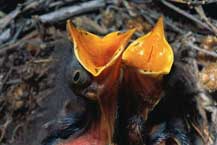
If you find a baby bird or mammal, do not automatically assume it is an orphan. The parent may be nearby, keeping an eye on it while waiting for you to go away. Remember many animals are good at hiding – it’s how they avoid being eaten. Often the best thing to do is leave it alone.
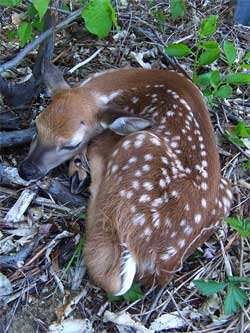 |
Does only feed their babies three or four times a day, for about 15 minutes each time. The rest of the time the fawn may be curled up on the ground. Just leave it be. Photo by Bet Zimmerman |
A human can not care for an animal or prepare it to survive in the wild as well as its natural parents. Young animals also need special diets – without them they will not develop properly. In addition, animals reared by humans may imprint on people and not be releasable.
A crow was rehabbed by someone who lived very near to the Kalamazoo Nature Center where Torrey Wenger works. “This crow got imprinted to people, or at least used to them,” said Wenger. “Once it was old enough to fledge, it was set loose. A little while later, the front desk at the Nature Center got a call about a "rabid crow" approaching people, making strange noises and threatening to bite. So the people hit it with a shovel. It flew off and was never seen again. As you've probably guessed, the young crow was begging for food. It hadn't realized that only certain humans would consider it part of their "flock." Well-intentioned actions can backfire, and humans are rarely the ones who pay the price,” notes Wenger. Sadly, the end result is often death. In addition, it is actually illegal to keep wild animals if you don’t have permits, even if you plan to release them.
If the animal is hurt or sick (bleeding, shivering, vomiting, attacked by a cat or dog), it may need medical care. Never attempt to handle a mammal that may have rabies - stumbling, staggering, walking in circles, dragging a limb or the hind end, or acting strangely (approaching people or pets in an aggressive manner).
Otherwise, while wearing thick gloves (since injured animals may bite or scratch), put it in a dark box lined with a towel in a quiet, dark area, away from children, cats and dogs. Call a wildlife rehabilitator for instructions. There are approximately 200 volunteer rehabilitators in CT who have the appropriate skills, training, experience and state authorization to care for sick, injured and orphaned wildlife. To find one, contact your local nature center, or the CT DEP Wildlife Division at 860.424.3011, or DEP Emergency Dispatch, at 860.424.3333 (after hours or on weekends), or check online at www.tc.umn.edu/~devo0028/contact.htm.
Here are some specific tips on what to do in the interim on the rare occasions when help is needed.
BABY BUNNY: When they are about five inches long (eyes open, ears up), young rabbits leave the nest and are completely independent. At this age, they only need help if they are injured. If you have to chase the rabbit to catch it, it does not need to be rescued! If a nest of very young rabbits is found or disturbed (like when you are mowing the lawn), put the babies back in the nest and cover them with a little grass, unless they are hurt or you are certain the mother is dead. Bunny moms only feed the babies at dawn and dusk, so you may not see them around.
BABY SQUIRREL: Sometimes an infant squirrel ends up on the ground after their nest is blown down during a storm. If you put them in a box at the base of the tree, the mother will probably come and get them.
BABY BIRD: Birds leave nests on their own when they are almost fully feathered. You may see them hopping around on the ground or perching. Many birds can not fly efficiently at this stage, but the parents will continue to feed them. Keep pets and children away. If you find a bird with no or few feathers, try to figure out where the nest is and put it back if you can reach the nest safely. Briefly handling the bird in order to return it to the nest will not cause the mother to abandon it. If you do not know where the nest is or can’t reach it, fashion a nest in a wicker basket or small plastic container (put holes in the bottom so it doesn’t fill with water.) Line it with paper towels. Hang the basket, or tack the plastic container to a tree as close as possible to where the original nest is. The parents will usually come by and feed the baby. If you are certain the mother is dead, or the baby is injured, bring it to a wildlife rehabilitator as soon as possible. |